


.svg) By - Gaurav Vermma
By - Gaurav Vermma  Featured Events
 May 01, 2026
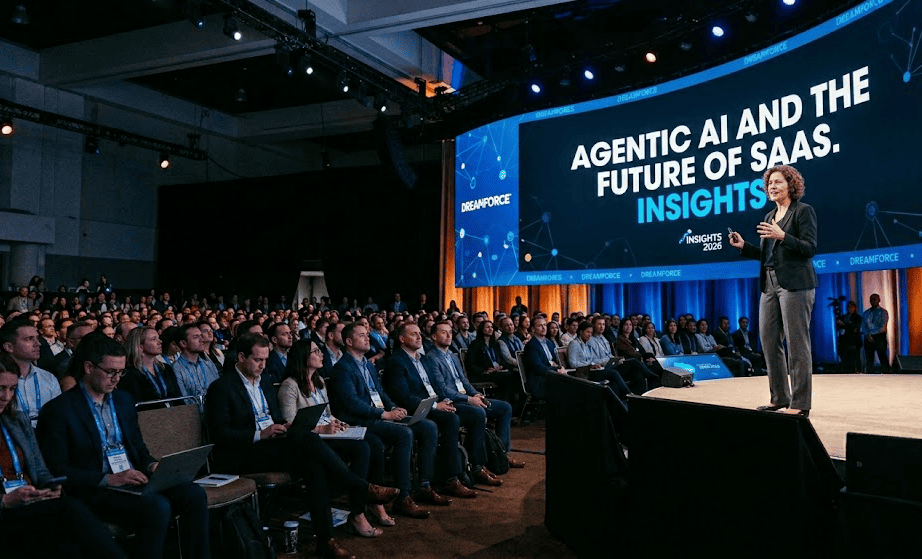
The Agentic Revolution: Dreamforce 2026 Redefined the Future of SaaS
For over two decades, the “Cloud” was the final frontier. We moved from on-premise servers to browser-based seats, and we thought we had reached the pinnacle of efficiency. But as the curtains closed on the most recent Dreamforce, a new reality set in: the “Software as a Service” (SaaS) model we’ve known is effectively dead.
In its place? The Agentic Enterprise.
We aren’t just talking about smarter chatbots or better autocomplete. We are talking about Agentic AI—autonomous digital entities that don’t just suggest work but actually execute it. If 2023 was the year of the prompt and 2024 was the year of the copilot, 2026 is officially the year of the Agent.
The Great Pivot: From Generative AI to Agentic Action
To understand the insights coming out of Dreamforce, we have to address the “Generative Fatigue” currently hitting the tech industry. Many businesses realized that while LLMs (Large Language Models) are great at talking, they are historically terrible at doing.
Generative AI is a spectator; it requires a human to take its output and put it into a system. Agentic AI, however, is a participant. It possesses “agency.” It can reason through a complex problem, break it down into a multi-step workflow, and interact with your CRM, your ERP, and your third-party APIs to finish the job.
Why This Matters for SaaS
In the traditional SaaS world, the software was a tool. You hired a human to “swing the hammer.” In the Agentic SaaS world, the software is the carpenter. This shift fundamentally changes how software is built, sold, and utilized across every industry.
1. The Dawn of Agentforce and Autonomous Ecosystems
The headline of Dreamforce was undoubtedly Agentforce. This represents a massive architectural shift within the Salesforce ecosystem, moving away from static automation (like Flow) toward dynamic, reasoning-based agents.
The core takeaway for business leaders is the Low-Code Agent Builder. This allows non-technical managers to “hire” an agent for a specific role—be it a “Service Agent” for handling complex returns or a “Sales Agent” for qualifying inbound leads.
Unlike the rigid “If/Then” logic of the past, these agents use hybrid reasoning. They look at the goal, look at the available data, and decide the best path forward. If they hit a roadblock, they don’t just fail; they recalibrate.
2. The Multi-Agent Orchestration Layer
One of the most profound insights shared during the technical sessions was the concept of Multi-Agent Systems (MAS). In the future, a single company won’t have “one AI.” They will have a fleet of specialized agents that talk to each other.
Imagine this workflow:
-
- Your Supply Chain Agent detects a delay in a shipping lane due to weather.
- It automatically pings the Inventory Agent, which updates stock levels in the system.
- The Marketing Agent receives a trigger to pause ads for the affected products.
- The Customer Service Agent proactively emails customers with pending orders, offering a discount code for the delay.
This isn’t science fiction. This is the Agentic Orchestration that SaaS platforms are currently racing to perfect. The challenge for 2026 isn’t making AI smart—it’s making AI interoperable.
3. Data 360: The Nervous System of the Agentic Enterprise
An agent is only as good as its memory. Dreamforce emphasized that for an agent to act autonomously, it needs a “unified truth.” This is where Data 360 (Data Cloud) comes in.
To avoid the “hallucinations” that plagued early AI, Agentic SaaS relies on RAG (Retrieval-Augmented Generation). By grounding the agent in your real-time company data—your customer purchase history, your Slack conversations, and your technical documentation—the agent can make decisions that are contextually accurate.
The SEO Takeaway: If you aren’t optimizing your “Data Hygiene,” your AI strategy will fail. SaaS providers are no longer just selling “features”; they are selling “Data Intelligence Layers.”
4. The End of “Per-Seat” Pricing?
Perhaps the most disruptive insight for the SaaS business model is the shift in monetization. For 20 years, SaaS companies grew by selling more “seats.” But if an agent can do the work of five people, seat counts will naturally drop.
We are seeing a move toward Outcome-Based Pricing.
-
- The Model: Instead of paying $100/user/month, a company might pay $2 per “successfully resolved customer issue” or $5 per “qualified sales meeting booked.”
- The Impact: This aligns the software vendor’s success directly with the customer’s success. It’s a high-stakes transition that will force SaaS companies to prove their value every single day.
5. Security and the “Human-in-the-Loop”
As agents become more autonomous, the conversation around AI Trust and Ethics has shifted. We are moving away from “black box” AI toward Transparent Autonomy.
At Dreamforce, the “Human-in-the-Loop” (HITL) framework was a recurring theme. This involves setting guardrails:
-
- Confidence Scores: An agent will only execute a refund if it is 95% sure it meets policy. If not, it flags a human.
- Audit Trails: Every decision an agent makes is logged, allowing managers to see exactly why an agent chose a specific path.
For SaaS developers, building “Auditability” is now just as important as building “Functionality.”
6. How to Prepare Your Business for the Agentic Era
You don’t need to be a Fortune 500 company to leverage these insights. Here is a roadmap for transitioning to an Agentic workflow:
-
- Identify “High-Volume, High-Context” Tasks: Look for roles that require a lot of data lookups but follow a general set of rules (e.g., Tier 1 support, billing disputes, lead scoring).
- Centralize Your Data: If your data is trapped in silos (spreadsheets, different CRMs), an agent won’t be able to “see” the full picture.
- Develop “Agentic Literacy”: Train your team not just to use AI, but to manage AI. The most valuable employees in 2026 will be “Agent Orchestrators.”
Conclusion: The New Standard
Dreamforce 2026 made one thing clear: the gap between those who use agents and those who don’t is about to become a canyon. Agentic AI is turning SaaS from a static tool into an active partner.
We are no longer just “using” software. We are collaborating with it. The future of SaaS isn’t just about code—it’s about agency, action, and the incredible potential of the Agentic Enterprise.